
Matrixyl (Palmitoyl Pentapeptide-4)
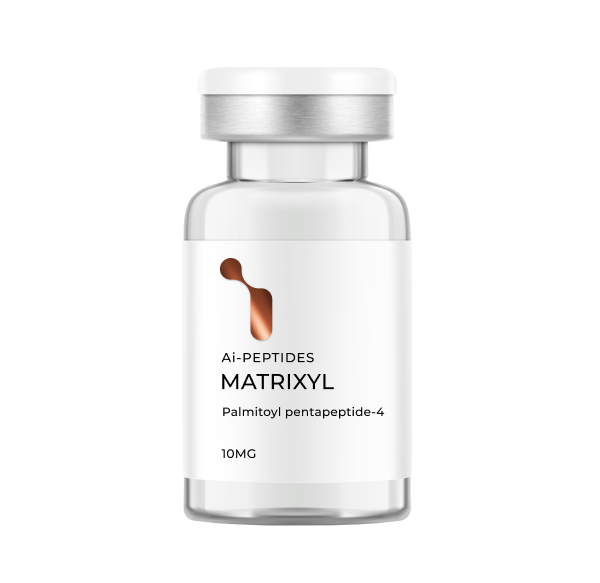
Matrixyl (Palmitoyl Pentapeptide-4)

 Crypto
Restock in progress. Add your email and we will tell you the moment this compound is back in stock.
One email when this is back in stock. No spam, unsubscribe anytime.
Product details
Matrixyl is a synthetic palmitoyl pentapeptide, the lipid-conjugated form of the pentapeptide KTTKS, a fragment released during the processing of type I procollagen. It belongs to the matrikine, or matrix-derived signalling peptide, class, in which the palmitoyl group is attached to the otherwise hydrophilic pentapeptide.
In the published preclinical literature, the KTTKS pentapeptide has been characterised at the molecular level in cultured dermal fibroblasts as a signal to the extracellular-matrix synthesis pathway, with studies assaying type I collagen, type III collagen and fibronectin protein synthesis, and a related analogue series assaying matrix-protein biosynthesis and proteolytic-enzyme activity at non-cytotoxic concentrations. It is supplied as a research compound and is not intended for human or veterinary use.
Full specifications
Complete your order
supplied for laboratory research only
Recently viewed
picks up where you left off
Research
Matrixyl is the palmitoylated form of the pentapeptide KTTKS, which has been characterised in preclinical laboratory models. The primary studies below, in cultured fibroblasts, assayed molecular endpoints of the extracellular-matrix synthesis pathway, with the work centred on how the matrix-derived pentapeptide signals to the cell. The literature is preclinical; it describes the compound, not any outcome in humans.
2 preclinical studies indexed · matrix-derived pentapeptide signalling in fibroblast culture · links open on PubMed
Matrix-derived pentapeptide signalling in fibroblast culture 2 studies
In vitro
A pentapeptide from type I procollagen promotes extracellular matrix production
In subconfluent cultured fibroblasts, the KTTKS pentapeptide released from the type I procollagen propeptide was assayed for its effect on extracellular-matrix protein synthesis, with type I collagen, type III collagen and fibronectin production measured in a dose- and time-dependent manner against total protein synthesis as the molecular endpoints.
Read the study ↗
In vitro
The effects of a novel series of KTTKS analogues on cytotoxicity and proteolytic activity
In fibroblast culture, a synthesised series of KTTKS and modified analogues was assayed for cytotoxicity, for amidolytic activity against urokinase, thrombin, trypsin, plasmin, t-PA and kallikrein, and for collagen and DNA biosynthesis, profiling the parent matrix-derived sequence against the lipidated analogues at the cellular level.
Read the study ↗
Links open the original study on PubMed. For research and educational purposes, descriptive of the published preclinical literature, not therapeutic claims about any ai-peptides product. A Certificate of Analysis and a Safety Data Sheet are available on request for every batch.
Reviews
Verified-order reviews on service, shipping, and product quality appear here once the first order is reviewed.