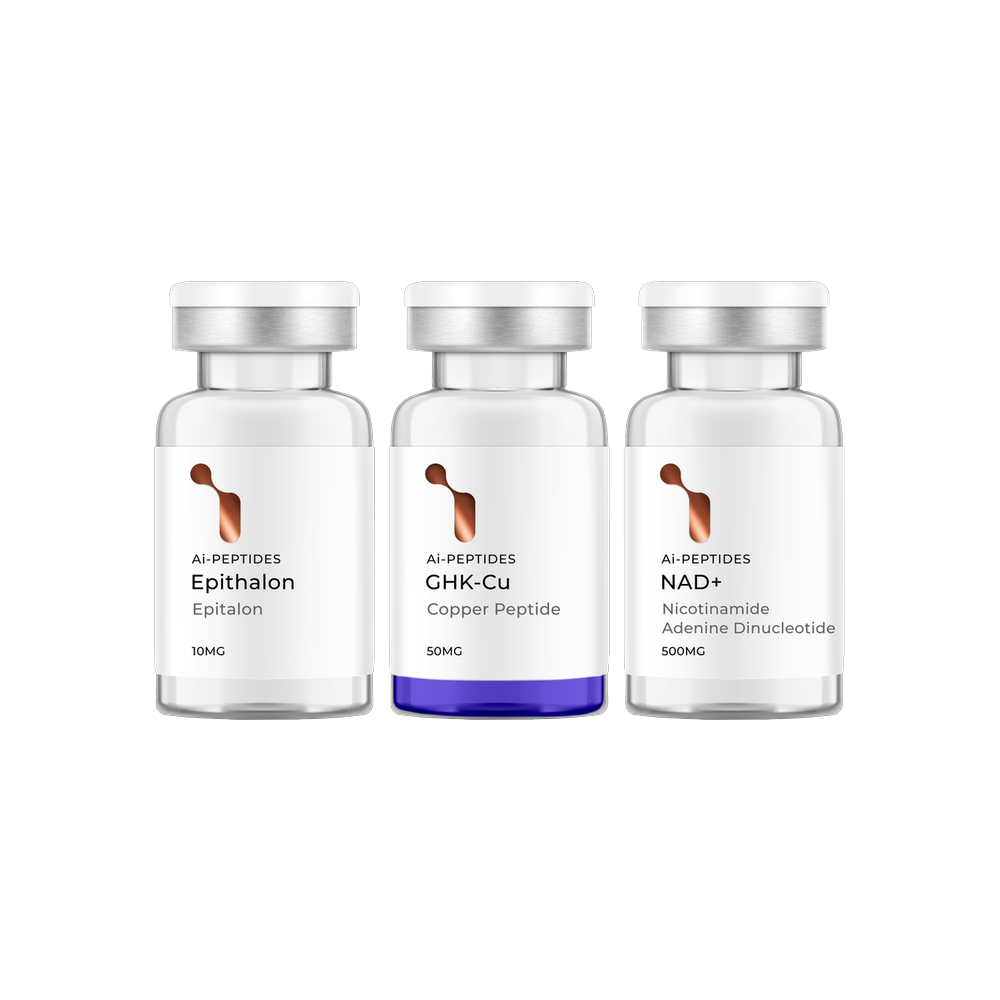
Series-3 Research Bundle
Series-3 Research Bundle

 Crypto
Restock in progress. Add your email and we will tell you the moment this compound is back in stock.
One email when this is back in stock. No spam, unsubscribe anytime.
Product details
Series-3 Research Bundle is supplied as a set of laboratory research compounds with defined reference identities. The set contains Epithalon, GHK-Cu, NAD+, each in its own vial.
This listing is limited to product identity, analytical documentation, and research-use status. Each component is provided for qualified laboratory research only and is not intended for human or veterinary use. Each batch is independently tested for identity, purity, and consistency, with a lot-specific Certificate of Analysis provided for documentation and internal research records.
Full specifications
Complete your order
supplied for laboratory research only
Recently viewed
picks up where you left off
Research
Each compound in this set has been characterised in preclinical laboratory models. The primary studies below, in animal and in-vitro models, examined cellular, biochemical, and mechanistic endpoints. The literature is preclinical: it describes the compounds, not any outcome in humans.
6 preclinical studies indexed · epithalon, ghk-cu and nad+ · links open on PubMed
Epithalon 2 studies
Animal modelEffect of epitalon on the lifespan increase in Drosophila melanogasterIn the Drosophila melanogaster model, the peptide was studied for an imago-lifespan endpoint, a geroprotection readout in an invertebrate model.Read the study ↗
In vitroEpitalon-activated telomerase enhance bovine oocyte maturation rate and post-thawed embryo developmentIn bovine cumulus-oocyte complexes in vitro, the peptide acted as a telomerase activator, linking cumulus-cell telomerase activity to oocyte-maturation endpoints.Read the study ↗
GHK-Cu 2 studies
In vitroStimulation of collagen synthesis in fibroblast cultures by the tripeptide-copper complex glycyl-L-histidyl-L-lysine-Cu2+In cultured fibroblasts, the copper complex dose-dependently raised collagen synthesis at the cell level.Read the study ↗
In vitroStimulation of sulfated glycosaminoglycan synthesis by the tripeptide-copper complex glycyl-L-histidyl-L-lysine-Cu2+In cultured fibroblasts, the copper complex dose-dependently increased sulfated glycosaminoglycan synthesis measured by 35S-sulfate incorporation.Read the study ↗
NAD+ 2 studies
Animal modelMuscle type-specific responses to NAD+ salvage biosynthesis promote muscle function in Caenorhabditis elegansIn C. elegans, perturbing the nicotinamide-NAD+ salvage pathway produced tissue-specific effects, implicating salvage-pathway flux as a determinant of tissue NAD+ supply.Read the study ↗
Animal modelAn NAD(+) biosynthetic pathway enzyme functions cell non-autonomously in C. elegans developmentIn C. elegans, loss of the NAD+ salvage enzyme PNC-1 drove developmental phenotypes cell non-autonomously, indicating the enzyme regulates NAD+ metabolite levels across tissues.Read the study ↗
Links open the original study on PubMed. For research and educational purposes, descriptive of the published preclinical literature, not therapeutic claims about any ai-peptides product. A Certificate of Analysis and a Safety Data Sheet are available on request for every batch.
Reviews
Verified-order reviews on service, shipping, and product quality appear here once the first order is reviewed.