
Trends in Peptide
Research As the ability to synthesize synthetic peptides has grown over the decades since the 1920s, something interesting has happened. Science has slowly but surely moved away from simply trying to mimic the structure of natural peptides, a practice which necessarily limited development to shorter peptides, and has instead focused on developing novel peptides that act on receptors of interest even if they bear no resemblance to native peptides.Trend in peptide length by decade:
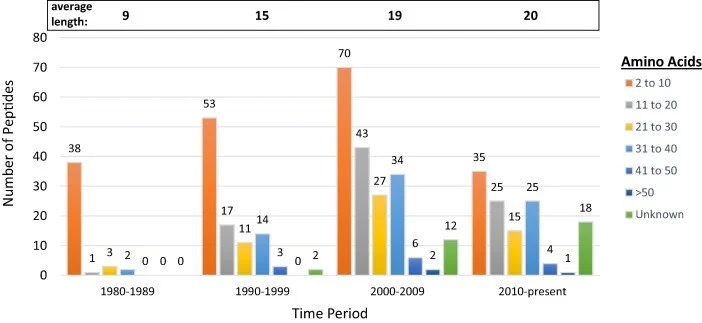
Source: Science Direct
On average, the development time for a peptide is about 9.4 years and there are often setbacks along the way. Sometimes, peptides that are rejected as unsuitable for use get a second chance when they are altered, combined with other peptides, or applied in a new setting. As the catalog of therapeutic peptides has grown, so too has the research grown with it. For instance, the rate of discovery of peptide-addressable targets for which no peptide has yet been discovered or developed has helped to spur a frenzy of research activity. For instance, development of a melanocortin 4 receptor (MC4R) agonist could be critical in the fight against obesity and is of intense research focus. Scientists have identified the receptor, now they are searching for a peptide that is specific for it. Additionally, peptide drug delivery techniques are constantly being advanced, making it possible for peptides that were once unstable, difficult to store, or complicated to administer to become more attractive as potential therapeutics.
The peptide categories discussed below are among the most hotly researched in the world. They contain peptides that have long been used in the clinical setting as well as peptides that are under active research. This is hardly an exhaustive list though. It is just a teaser to introduce the world of peptides research.