
KISSPEPTIN
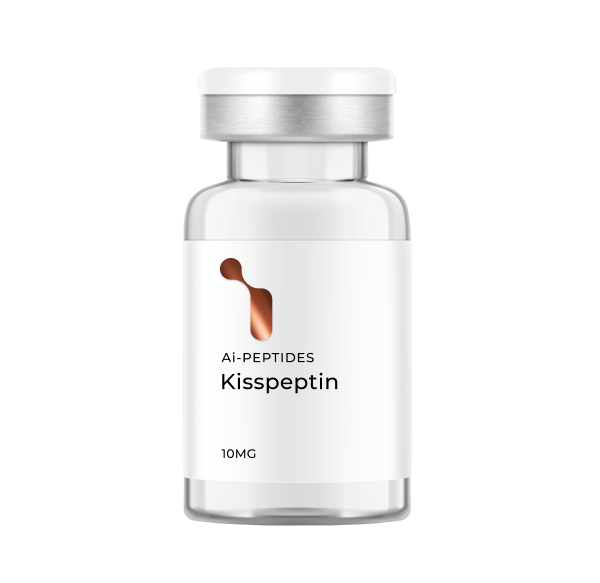
KISSPEPTIN

 Crypto
Restock in progress. Add your email and we will tell you the moment this compound is back in stock.
One email when this is back in stock. No spam, unsubscribe anytime.
Product details
Kisspeptin is a peptide encoded by the KISS1 gene and the natural ligand of KISS1R, the G protein coupled receptor formerly known as GPR54. It belongs to the receptor-binding RFamide peptide class.
In the published preclinical literature, kisspeptin has been characterised at the molecular and cellular level as an agonist at the KISS1R (GPR54) receptor: in cell-based assays it binds and activates the receptor and engages phospholipase C, calcium, and MAP-kinase signalling, and in rodent brain-slice electrophysiology it acts on the ion channels of gonadotropin-releasing-hormone neurons. It is supplied as a research compound and is not intended for human or veterinary use.
Full specifications
Complete your order
supplied for laboratory research only


Recently viewed
picks up where you left off
Research
Kisspeptin has been characterised in preclinical laboratory models. The primary studies below, in cultured cells and in rodent brain-slice electrophysiology, measured receptor-binding and receptor-activation endpoints at the KISS1R (GPR54) receptor and the ion-channel behaviour of gonadotropin-releasing-hormone neurons. The literature is preclinical; it describes the compound, not any outcome in humans.
3 preclinical studies indexed · receptor binding and activation and ion-channel mechanism in neurons · links open on PubMed
Ion-channel mechanism in neurons 2 studies
Animal model
Kisspeptin excites gonadotropin-releasing hormone neurons through a phospholipase C and calcium-dependent pathway regulating multiple ion channels
In acute brain slices from transgenic mice, perforated-patch electrophysiology and calcium imaging recorded the firing of gonadotropin-releasing-hormone neurons and mapped the kisspeptin response to a phospholipase C and calcium-dependent pathway acting on multiple ion channels as electrophysiological endpoints.
Read the study ↗
Animal model
Kisspeptin depolarizes gonadotropin-releasing hormone neurons through activation of TRPC-like cationic channels
In mouse brain slices, voltage-clamp and current-clamp recordings measured a concentration-dependent depolarisation of gonadotropin-releasing-hormone neurons, with the underlying current traced to the inhibition of inwardly rectifying potassium channels and the activation of TRPC-like cationic channels as measured endpoints.
Read the study ↗
Links open the original study on PubMed. For research and educational purposes, descriptive of the published preclinical literature, not therapeutic claims about any ai-peptides product. A Certificate of Analysis and a Safety Data Sheet are available on request for every batch.
Reviews
Verified-order reviews on service, shipping, and product quality appear here once the first order is reviewed.